
· By Austin McKnight
The $131,734 Question: Why We Can't Build Our Way to Affordability With Regulation Costs This High
Government regulation now adds $131,734 to the price of a new home — up more than 40% since 2021. A look at NAHB's updated study and what it means for housing affordability.
- Housing Market
I spent the better part of the last two weeks listening to economists talk about housing — first in Washington, D.C. at the National Association of Home Builders' Spring Leadership Meeting and Legislative Conference, and then back home in Texas at the Greater Houston Builders Association's mid-year economic review. In both rooms, the headliner was Robert Dietz, NAHB's chief economist, and I had the chance to hear him break down the housing outlook several times over.
He covered a lot of ground — rates, inventory, the construction labor pipeline, the lingering drag of building-material costs. All of it matters. But one figure from NAHB's newly updated research has stayed with me more than any other, and I think it deserves a wider audience than the conference halls it was presented in.
Nearly a quarter of a new home's price is regulation
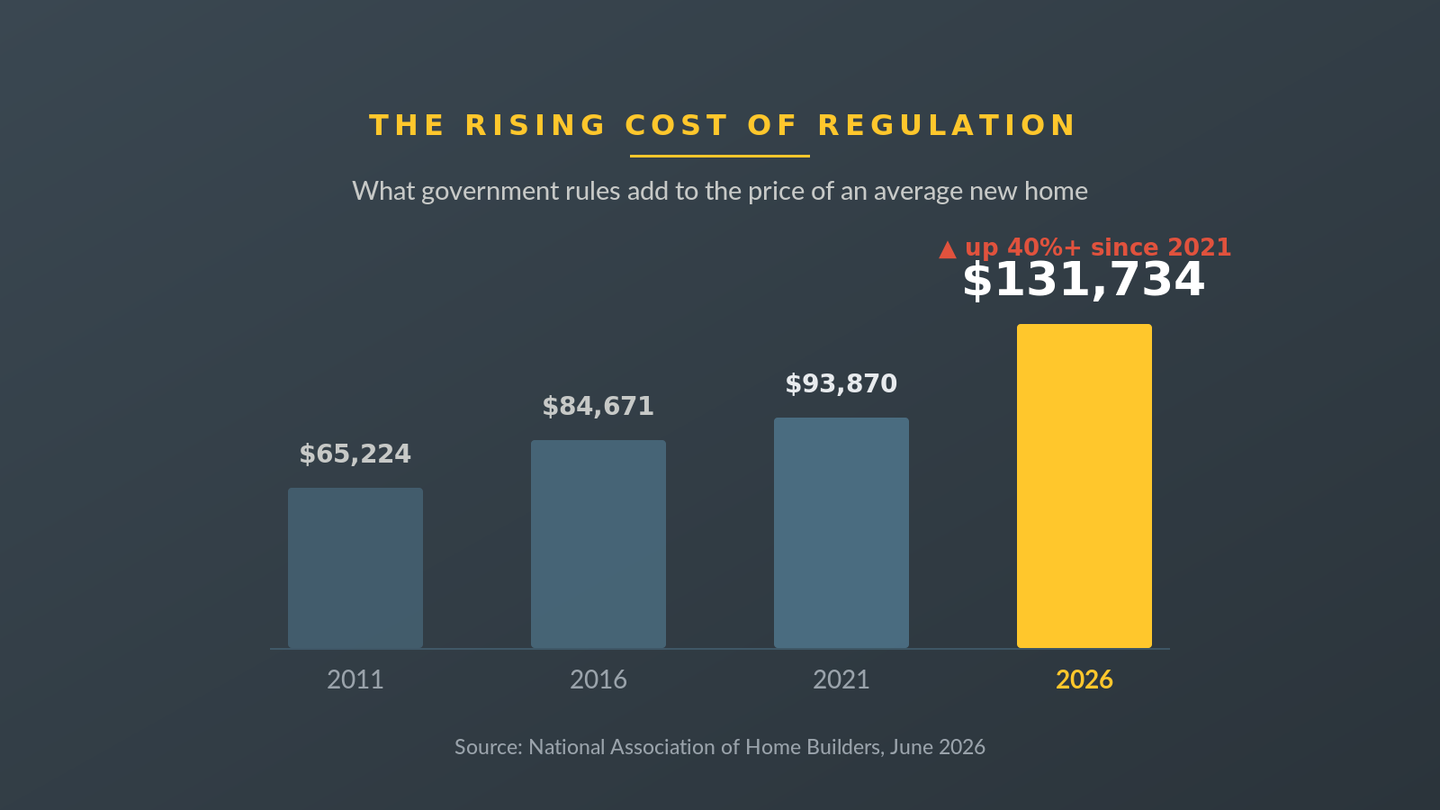
NAHB's updated study, Government Regulation in the Price of a New Home: 2026, released June 9, puts a hard number on something the industry has long felt but rarely quantified. Regulation imposed by federal, state, and local governments now accounts for $131,734 of the price of the average new single-family home — equal to 26.4% of the average $499,500 sale price as of January 2026.
Read that again. Roughly one out of every four dollars a buyer pays for a new home is the cost of regulation.
The study breaks the total into two phases. About $46,795 comes from regulation during land development — zoning approvals, impact fees, required studies, land that must be dedicated to the government or left unbuilt. The larger share, $84,939, is incurred during construction of the home itself: building permit and inspection fees, architectural standards, and changes to building codes.
To be clear, and NAHB is careful to make this point: this is not an argument that all regulation is bad or should be eliminated. Worker safety, sound development, and sensible standards have real value. The study isn't trying to separate "good" regulation from "excessive" regulation. It's simply putting a credible dollar figure on the total — so that when we debate new rules or revisit old ones, we're doing it with the full cost in view.
The trend line is the real story
A single snapshot is striking. The trajectory is alarming.
That $131,734 is up more than 40% from the 2021 study's $93,870 — the largest increase NAHB has ever recorded between consecutive surveys. Step back further and the climb is relentless: it's up 56% from the 2016 figure of $84,671, and roughly double the 2011 estimate of $65,224.
It's fair to note that a 40% jump in cost doesn't translate to a 40% jump in the monthly payment — we finance homes, so the cost is amortized over decades rather than paid up front. But that's cold comfort, for two reasons. First, because it's mortgaged, the buyer pays interest on that regulation for the life of the loan: the full $131,734 financed at today's rates runs roughly $860 a month, and well over a quarter-million dollars across 30 years. Amortization softens the monthly blow but multiplies the lifetime cost.
Second — and this is the part that actually prices people out — regulation raises the bar to qualify, not just the bar to pay. That extra cost inflates the down payment a buyer must bring in cash, and it requires meaningfully more annual income to clear standard debt-to-income limits. Buyers don't get squeezed by a slightly higher payment; they get knocked out at the qualification stage before they ever make an offer. No amount of rate relief fixes a cost that's baked into the price of the house itself.
Where the costs are growing fastest
The study also shows where the pressure is building. Interestingly, the regulatory share during land development actually fell slightly, from 10.5% in 2021 to 9.4% in 2026. The increase came almost entirely from the construction phase, which rose from 13.3% to 17.0% of the final house price.
The single most expensive line item? Changes to building codes over the past 10 years, which now account for 8.1% of a home's price — about $40,288 per home, more than twice as costly as any other category measured. Higher building permit and impact fees followed close behind.
None of this is abstract to anyone who works in or around homebuilding. It's the fee schedule that grows every cycle, the code revision that adds cost without an obvious offsetting benefit to the buyer, the months of carrying costs that accrue while a project waits on approvals.
Why this matters for the housing shortage
NAHB estimates the United States has a structural housing deficit of roughly 1.2 million homes — the cumulative gap between what we've built and what the market needs. Closing that gap depends on builders being able to deliver homes at prices buyers can actually afford.
Regulation at current levels works directly against that goal. Every six-figure regulatory load baked into a new home prices another tranche of buyers out of the market, and discourages the entry-level construction the country needs most. You cannot simultaneously call for more affordable housing and pile on costs that grow twice as fast as wages. The math doesn't reconcile.
The honest conversation
What I appreciated most about hearing Dietz lay this out — in D.C. and again in Houston — is that NAHB isn't framing this as a crusade against regulation. It's framing it as a call for honesty. If we're going to take housing affordability seriously, the cost of regulation has to be on the table alongside rates, land, labor, and materials. Right now it too often isn't.
The first step toward fixing any problem is being willing to measure it. NAHB has done that. The harder question — the $131,734 question — is what we're willing to do about it.
Sources
- National Association of Home Builders, Government Regulation in the Price of a New Home: 2026 (Special Study for Housing Economics, Eric Lynch, CBE), June 8, 2026. Full study (PDF)
- National Association of Home Builders, "Regulatory Costs Jump 40% in Five Years, Add $131,734 to New Home Prices," press release, June 9, 2026. Read the release
- Robert Dietz, NAHB Chief Economist — remarks at the NAHB Spring Leadership Meeting & Legislative Conference (Washington, D.C., June 2026) and the Greater Houston Builders Association Mid-Year Economic Review (Houston, June 16, 2026).

